Friday, March 2, 2018

New England Red Earthenware Workshop to be Held at Historic New England on March 22 with the Ceramics Study Club of Boston

I would like to announce this morning that I will be speaking at Historic New England later this month on Thursday March 22. The museum has asked me to talk about eighteenth and nineteenth century red earthenware production in New England, as part of a workshop that will be held with the Ceramics Study Club of Boston, which is formerly known as the China Students Club and founded in 1934.

Historic New England has requested that I select a group of red earthenware from the museum's collection, and each object will then be discussed and further analyzed. Right now the goal is for those objects to be chosen a few days before the workshop - I plan to go through the collection and try to find the best objects in order to describe and demonstrate the history of red earthenware production in New England from both an aesthetic and historical point of view.

As many of you already know, Historic New England's selection of pottery is among the best collections of New England-made red earthenware to exist in the country today. There are many rare examples with incredible provenances from the eighteenth and nineteenth centuries, which include locally-made objects that predate the American Revolution.

I'm definitely excited for the opportunity to explore this collection, and examine a number of the museum's really special objects; however, I am also hopeful that I will learn some new information from the members of the Ceramics Study Club of Boston who attend the workshop.

I'm not sure if there is room for others to attend who are not already a member of the society, but I would suggest contacting Historic New England for anyone who may be interested. It should be a really fun event.

Note: The image that I have posted today is an example of some of the red earthenware that is currently in the museum's storage facility in Haverhill, Massachusetts. But this is merely just an example - there is so much more to see from this collection that the museum began assembling more than 100 years ago. I should also note that not every object owned today by Historic New England was made in New England; although, almost every object retains a great provenance and history of ownership in New England, which makes some of the objects produced elsewhere in America a fascinating study, as well.

Examples of Red Earthenware Owned by Historic New England
Historic New England Will be Holding a Red Earthenware Workshop on March 22, 2018
See Article for More Information
Photo Courtesy: Historic New England

Please Stay Tuned...Much More to Come...

Thursday, March 1, 2018

A Slip-Decorated Red Earthenware Bottle that Retains a 20th Century History of Ownership in Pennsylvania

This morning's article shows a finely thrown slip-decorated red earthenware bottle that I believe was produced sometime around the turn of the nineteenth century, but it may have been made earlier, as well. I purchased it years ago from Robesonia, Pennsylvania antiques dealer, Greg Kramer who had acquired it from the lifelong collection of Lester Breininger (1935-2011), an accomplished and influential twentieth and twenty-first century Pennsylvania-German potter who also lived in Robesonia.

Greg told me that he had originally sold this bottle to Lester, and it was discovered in Pennsylvania in the 1970s or 1980s. I was also told that Lester had owned it for decades; although, I was not able to obtain any further information. But I assume there must have been a reason why Lester owned such an object, considering the amount of knowledge that he possessed.

Lester Breininger, Pennsylvania-German Potter
20th Century Image of Lester Breininger with a Pot Made by Potters at His Pottery
The Pot was Made by Master Potter, Greg Zieber and Slip Trailed by Wesley Muckey
Lester Breininger Owned the Bottle Discussed in this Article for Decades
See Article for More Information
Photo Courtesy: Reading, PA Eagle

Nevertheless, I have not been able to determine a specific origin for this bottle; however, I have always regarded it as an object that could have been made in either North Carolina or Pennsylvania. I have repeatedly leaned more towards eastern Pennsylvania, but I have yet to find any evidence to support such a claim.

There have been numerous times now that I have written on this website that attributions should not be developed based on merely just a glaze, whereas it should always be about the form first. But this glaze may be an exception since it reminds me of various objects that were produced in North Carolina in the eighteenth and early-nineteenth centuries, as well as some of the sgraffito decorated objects manufactured throughout Pennsylvania during the same time period.

I am certainly open to opinions and thoughts about this object if there is anyone reading this who can provide legitimate evidence, preferably archaeological artifacts, which could possibly support an attribution. I also want to reiterate that this is a finely thrown bottle made by a skilled potter, and the glaze also appears accomplished.

To my knowledge, this is the only object known today that displays this combination of form and glaze. I have not been able to locate any similar objects or related artifacts in any of the museum collections, private collections or archaeology collections that I have studied.

Slip-Decorated Red Earthenware Bottle
 18th/19th Century Slip-Decorated Red Earthenware Bottle
Reportedly Retains 20th Century History of Ownership in Pennsylvania
Stands 7 7/8" Tall
See Article for More Information
 Another View of the Bottle
See Article for More Information
 Another View of the Bottle
See Article for More Information
 View of the Interior
See Article for More Information
View of the Base
See Article for More Information

Please Stay Tuned...Much More to Come...

Wednesday, February 28, 2018

18th Century Earthenware Teapot Owned by the National Museum of American History at the Smithsonian in Washington, D.C.

Last week, I posted an article about a circa 1766 earthenware (or creamware) teapot that I have always admired, which is currently on display at the Peabody Essex Museum in Salem, Massachusetts. This object was reportedly made at the Cockpit Hill Factory in England in recognition of an Act passed by Parliament to repeal the Stamp Act on March 18, 1766. The words "Stamp Act Repeal'd" are prominently inscribed across the front of the teapot

According to Yale University, "The Stamp Act was passed on March 22, 1765, leading to an uproar in the colonies over an issue that was to be a major cause of the American Revolution: taxation without representation. Enacted in November 1765, the controversial act forced colonists to buy a British stamp for every official document they obtained. The stamp itself displayed an image of a Tudor rose framed by the word "America" and the French phrase "Honi soit qui mal y pense" - or Shame to him who thinks evil of it." 

Nonetheless, I also cited a related eighteenth century earthenware teapot in that same article that I viewed during one of my trips in 2017 to the National Museum of American History at Smithsonian in Washington, D.C. Whereas, it was also brought to my attention last week by museum consultant, Robert F. Trent that this teapot had been previously owned by Connecticut antiques dealer, William Guthman (1924-2006) before it was later acquired by the Smithsonian from Northeast Auctions in Portsmouth, New Hampshire in 2006.

Furthermore, this teapot is also reported to have been made at the Cockpit Hill Factory in England, circa 1766-1770, while it also observes the repeal of the Stamp Act. Imprinted on one side of the teapot is "No Stamp Act" and on the other is "America. Liberty Restored."

Note: Here is a link to a press release that was posted on the National Museum of American History's website in 2006, which further explains the significance of this important object that is currently on display at the Smithsonian in Washington, D.C.

Teapot Acknowledging the Repeal of the Stamp Act
18th Century English Earthenware Teapot
Attributed to the Cockpit Hill Factory in England
Imprinted "No Stamp Act / America. Liberty Restored."
Circa 1766-1770
See Article for More Information
Photo Courtesy: The National Museum of American History at the Smithsonian

Circa 1765/66 Stamp Act Stamp
See Article for More Information
Photo Courtesy: Mystic Stamp Company - Camden, NY

Please Stay Tuned...Much More to Come...

Monday, February 26, 2018

Collections of Red Earthenware that were Published in 1929 in 'The Pine Furniture of Early New England'

I previewed a John McInnis estate auction yesterday in Newburyport, Massachusetts, which included a large collection of regionial ephemera and books from local homes. Out of pure curiosity, I picked up a book written by Russell H. Kettell, titled 'The Pine Furniture of Early New England.' The book had been originally published in 1929 with subsequent matching editions published, thereafter. I was surprised to see a few collections of red earthenware displayed on furniture in this book that had been assembled by collectors who lived north of Boston before 1929.

I was probably most impressed with the objects that had been acquired by Mr. A.G. Baldini in Wakfield, Massachusetts. His collection included four pieces of nineteenth century red earthenware attributed to the Ezra Porter Pottery in Wiscasset, Maine; although, other notable objects involved a wonderful circa 1866-1906 multi-slip-decorated red earthenware pitcher from the Charles A. Lawrence Pottery in Beverly, Massachusetts, as well as an early-nineteenth century red earthenware jar attributed to the industry in southeastern Massachusetts.

However, objects from the Oliver E. Williams Collection in Rockport, Massachusetts were also pictured, which is an antiques collection that I have previously written about that was sold by Richard Withington in 1966. Kettell did not publish much red earthenware from Williams' collection, but the illustration did remind me of an article that I wrote in 2016 after Skinner sold Lewis Scranton's Collection at an onsite sale in Killingworth, Connecticut.

There was also red earthenware illustrated from the King Hooper House Collection in Marblehead, Massachusetts, which closely resembles a display that Nina Fletcher Little put together at Cogswell's Grant in Essex, Massachusetts. Interestingly, I also believe the display in Marblehead predated how Little exhibited her red earthenware, and I assume that the cupboard in the King Hooper House may have provided Little with some inspiration.

The last group of red earthenware that I found displayed in this book was owned by Mr. Albert H. Atkins in West Gloucester, Massachusetts; whereas, some of the slipware that he owned is illustrated, including a great nineteenth century red earthenware charger attributed to Norwalk, Connecticut, inscribed in slip, "Money Wanted." The side of a nineteenth century slip-decorated red earthenware plate from Long Island can also be seen.

Note: Russell H. Kettell wrote that all of the red earthenware on display at the King Hooper House in Marblehead, Massachusetts around 1929 came from Henry Francis Dupont's (1880-1969) Collection at Winterthur in Delaware. He wrote that it was also all from Pennsylvania; however, I can clearly see a number of New England-made objects in this illustration. It is possible that some of the pottery came from Dupont's collection (such as the slip-decorated plates and dishes), but it is obvious that many of the objects shown are from nineteenth century potters in New England, as well.

The Pine Furniture of Early New England, Original 1929 Edition
The Pine Furniture of Early New England
By Russell H. Kettell
First Published in 1929
The Book's Illustrations Include Red Earthenware Collections Displayed in the 1920s
See Article for More Information
Photo Courtesy: The Pine Furniture of Early New England, 1929

Mr. A.G. Baldini Collection, Wakefield, Mass.
 Collection of Mostly Red Earthenware on Display in Wakefield, Mass. Around 1929
See Article for More Information
Photo Courtesy: The Pine Furniture of Early New England, 1929
 Top Shelf: Small Pitchers to Left & Right Attributed to Porter Pottery in Wiscasset, ME
See Article for More Information
Photo Courtesy: The Pine Furniture of Early New England, 1929
 Middle Shelf: Two Jugs Attributed to the Porter Pottery in Wiscasset, ME
Jar Attributed to Southeastern Massachusetts
See Article for More Information
Photo Courtesy: The Pine Furniture of Early New England, 1929
 Collection of Red Earthenware on the Bottom Shelf
See Article for More Information
Photo Courtesy: The Pine Furniture of Early New England, 1929
 Bottom Right: Pitcher Attributed to C.A. Lawrence Pottery in Beverly, Mass.
Circa 1866-1906
See Article for More Information
Photo Courtesy: The Pine Furniture of Early New England, 1929
Description of this Page in The Pine Furniture of Early New England
See Article for More Information
Photo Courtesy: The Pine Furniture of Early New England, 1929

King Hooper House Collection, Marblehead, Mass.
 Collection of Red Earthenware in the King Hooper House in Marblehead, Mass. Around 1929
Objects from Many Regions are Represented Including Pennsylvania and New England
See Article for More Information
Photo Courtesy: The Pine Furniture of Early New England, 1929
 A Closer Look at the Collection
Objects from Many Regions are Represented Including Pennsylvania and New England
See Article for More Information
Photo Courtesy: The Pine Furniture of Early New England, 1929
19th Century Red Earthenware Jug in King Hooper House in Marblehead, Mass.
See Article for More Information
Photo Courtesy: The Pine Furniture of Early New England, 1929
 19th Century Pennsylvania Slipware Dish in King Hooper House in Marlbehead, Mass.
See Article for More Information
Photo Courtesy: The Pine Furniture of Early New England, 1929
Description of this Page in The Pine Furniture of Early New England
See Article for More Information
Photo Courtesy: The Pine Furniture of Early New England, 1929


Mr. Oliver E. Williams Collection, Rockport, Mass.
 19th Century Red Earthenware (or Possibly Stoneware) Jug
Picture from Oliver E. Williams Collection in Rockport, Mass.
See Article for More Information
Photo Courtesy: The Pine Furniture of Early New England, 1929
 Another View of the Jug
See Article for More Information
Photo Courtesy: The Pine Furniture of Early New England, 1929
Description of this Page in The Pine Furniture of Early New England
See Article for More Information
Photo Courtesy: The Pine Furniture of Early New England, 1929

Mr. Albert H. Atkins Collections, West Gloucester, Mass.
19th Century Slipware Owned by Mr. Albert H. Atkins in West Gloucester, Mass. Around 1929
See Article for More Information
Photo Courtesy: The Pine Furniture of Early New England, 1929
 19th Century Red Earthenware Plate "Money Wanted"
Attributed to Norwalk, CT
See Article for More Information
Photo Courtesy: The Pine Furniture of Early New England, 1929
 Slipware in Mr. Albert H. Atkins' Collection
Bottom Shelf: 19th Century Long Island Slip-Decorated Red Earthenware Plate
See Article for More Information
Photo Courtesy: The Pine Furniture of Early New England, 1929
Description of this Page in The Pine Furniture of Early New England
See Article for More Information
Photo Courtesy: The Pine Furniture of Early New England, 1929

Please Stay Tuned...Much More to Come...

Friday, February 23, 2018

18th Century Earthenware Teapot Owned by the Peabody Essex Museum in Salem, Massachusetts

This is an eighteenth century earthenware (or creamware) teapot that I always enjoy visiting whenever I stop at the Peabody Essex Museum in Salem, Massachusetts. The teapot was manufactured about 1766 at the Cockpit Hill Factory in England to celebrate the repeal of the Stamp Act.

According to Salem State University, "Many colonists were against the Stamp Act largely because it was imposed upon them; formerly, colonial governments passed their owns Acts to raise funds as required. The colonial response was to organize, protest the Act, and confiscate the stamps.

In Boston, one group mobilized and forced the stamp distributor, Andrew Oliver (1706-1774), to resign. Crowds hanged Oliver's effigy, ransacked his home, and tore down the Stamp Office. One of the goods taxed by the Stamp Act was tea; it is not surprising, then that teapots were one of the means for expressing political thought.


Amidst the colonial protest, politics in Britain were also turbulent. George Grenville (1712-1770) was dismissed (as Prime Minister in Britain), and in March 1766, the Stamp Act was repealed. Colonists rejoiced. The broad protest and success in repealing the Stamp Act was an early moment of unity among the American Colonies. 

This British-made teapot is imprinted to convey the repeal of the contentious legislation, and reveals the strength and continuity of ties between Great Britain and her American Colonies."

Note: Here is a link to a related earthenware teapot that is owned today by the National Museum of American History at the Smithsonian, which is also believed to have been made at the Cockpit Hill Factory in England, circa 1766-1770. Inscribed on one side of the teapot is "No Stamp Act" and on the other is "America. Liberty Restored." Here is also another link that describes the history of the teapot owned by the Smithsonian, which had previously been owned by William Guthman in Connecticut before the museum acquired it from Northeast Auctions in New Hampshire in 2006.

Teapot Acknowledging the Repeal of the Stamp Act
18th Century English Earthenware Teapot
Attributed to the Cockpit Hill Factory in England
Imprinted "Stamp Act Repeal'd
Circa 1766
See Article for More Information
Photo Courtesy: Peabody Essex Museum - Salem, MA

Cartoon Depicting the Repeal of the Stamp Act
18th Century Cartoon Depicting the Repeal of the Stamp Act
Circa 1766
See Article for More Information
Photo Courtesy: Library of Congress

Please Stay Tuned...Much More to Come...

Wednesday, February 21, 2018

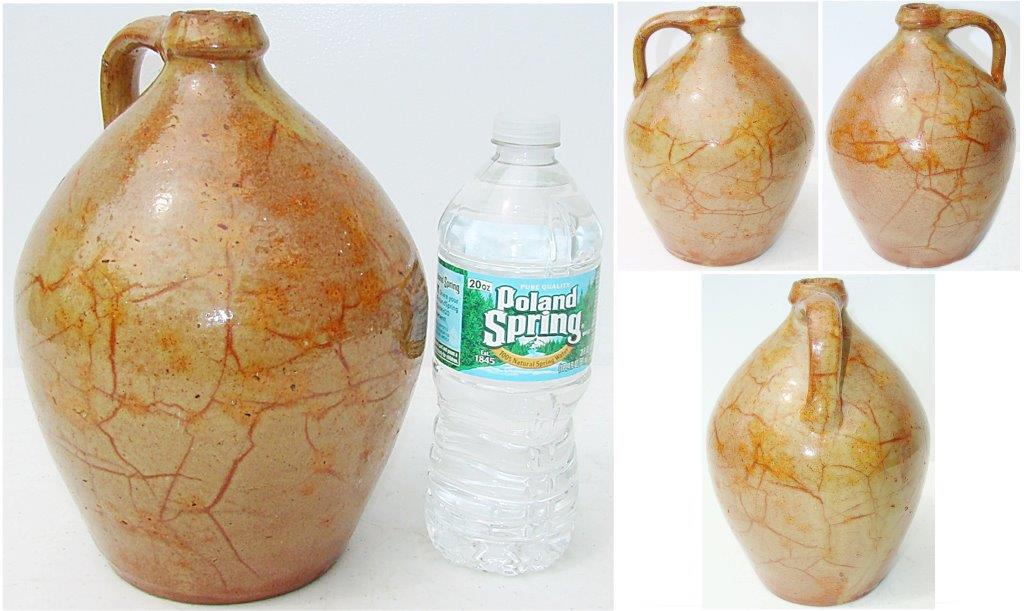
A Colorful 19th Century Red Earthenware Jug that Recently Sold in New Hamburg, Ontario

Earlier this month, a nineteenth century red earthenware jug sold in New Hamburg, Ontario that is decorated in a style of glaze that is commonly attributed to a number of regions today. As a result, I thought this would be an excellent example to post on this website in order to show why attributions should never be developed on just a glaze.

The colorful glaze found on this jug can be represented for red earthenware manufactured in Maine, Vermont, western New York and Ontario in the 1800s. In fact, somewhat of a similar manufactured jug sold a few years ago at a Tim Gould auction in Augusta, Maine that had been attributed to Maine based on the glaze, and possibly the fact that it was found in Maine. But the form of the jug suggested otherwise, possibly having originated in Ontario (or western New York).

It would be a similar scenario with this jug had it been discovered anyplace other than Canada - for example, I could easily see this jug attributed to Maine today because of the so-called "Maine glaze." Although, I could also see it mistaken for some of the colorful products, which were produced in Vermont during the circa 1790-1830/40 period, as well as the potteries in western New York after 1840. But the form is what identifies this product with Ontario, instead of the other locations. I have never seen such a form properly associated with Maine, Vermont or western New York before.

Nevertheless, an educated attribution always begins with the form, and from there, the glaze can be compared to known objects; however, the form is where it all begins.

Red Earthenware Jug from Ontario
19th Century Red Earthenware Jug Attributed to Ontario
Reportedly Measures 1/4 Gallon in Size
Link to Auction Listing
 See Article for More Information
Photo Courtesy: Miller & Miller Auctions - New Hamburg, ON
View of the Handle
See Article for More Information
Photo Courtesy: Miller & Miller Auctions - New Hamburg, ON

Please Stay Tuned...Much More to Come...

Monday, February 19, 2018

Another Upcoming Feature Story in Maine Antique Digest: The Potter's Industry in Southeastern Massachusetts

This morning, I would like to announce that Maine Antique Digest will be publishing another feature story that I have written - whereas, this story is about the eighteenth and nineteenth century potter's industry in southeastern Massachusetts. The article will feature some never before published material, such as archaeology from Boston, southeastern Massachusetts and Rhode Island, merchant account books, and a variety of solid information from historical societies and museums, like the Little Compton Historical Society in Rhode Island and Winterthur's Library in Delaware. There will also be a number of exciting images that will accompany the article from museums, current private collections and past private collections.

I also discuss the important role that Rhode Island played with this industry, and how it was a major export opportunity for the potters in southeastern Massachusetts. For instance, some of the early-twentieth century collectors felt a lot of the material recovered in Rhode Island was also made there because of the context for which it had been discovered; however, I try to dismiss this notion in this article with some of these objects, and show that they were merely exported to the area to fill a need in the eighteenth and nineteenth centuries.

I will post on this website the exact month and issue that this feature story will be published, but I expect it will be sooner rather than later.

Note: I should also note that I have an upcoming feature story and feature interview in Antiques and the Arts Weekly that was scheduled to be released this month, but it appears that they are now being held until next month. I also have two feature stories that I have already completed for the New England Antiques Journal, which will be released later this year.

Green-Glazed Red Earthenware Pitcher
18th/19th Century Red Earthenware Pitcher Attributed to SE Mass.
This Form has Previously Been Attributed to East Greenwich, RI, Circa 1771-1783
The Article Will Take a Close Look at the Type of Wares Available in RI
See Article for More Information
Photo Courtesy: Old Sturbridge Village - Sturbridge, Mass.

Please Stay Tuned...Much More to Come...