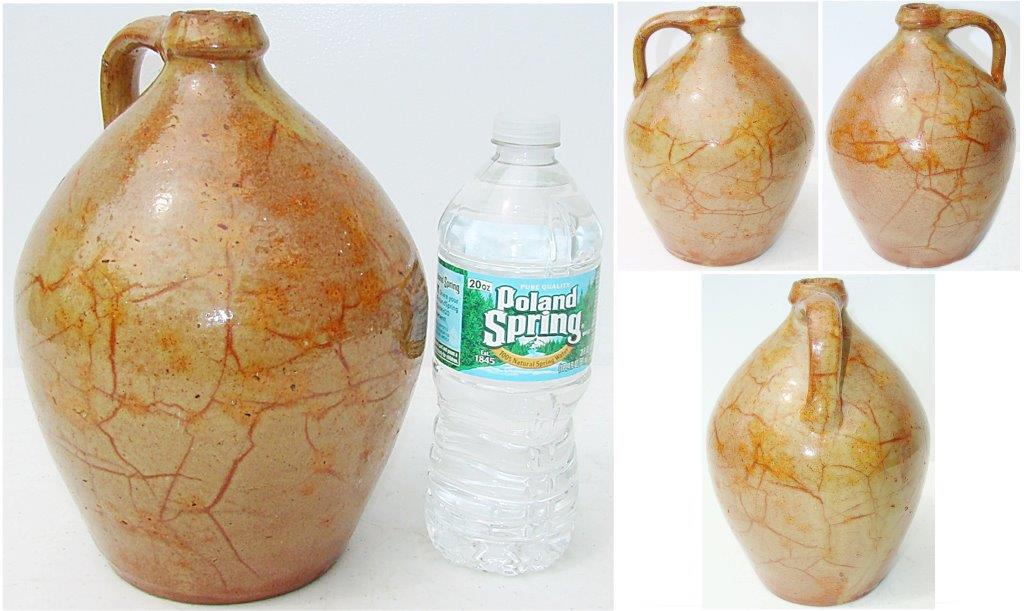
Wednesday, February 28, 2018

18th Century Earthenware Teapot Owned by the National Museum of American History at the Smithsonian in Washington, D.C.

Last week, I posted an article about a circa 1766 earthenware (or creamware) teapot that I have always admired, which is currently on display at the Peabody Essex Museum in Salem, Massachusetts. This object was reportedly made at the Cockpit Hill Factory in England in recognition of an Act passed by Parliament to repeal the Stamp Act on March 18, 1766. The words "Stamp Act Repeal'd" are prominently inscribed across the front of the teapot

According to Yale University, "The Stamp Act was passed on March 22, 1765, leading to an uproar in the colonies over an issue that was to be a major cause of the American Revolution: taxation without representation. Enacted in November 1765, the controversial act forced colonists to buy a British stamp for every official document they obtained. The stamp itself displayed an image of a Tudor rose framed by the word "America" and the French phrase "Honi soit qui mal y pense" - or Shame to him who thinks evil of it." 

Nonetheless, I also cited a related eighteenth century earthenware teapot in that same article that I viewed during one of my trips in 2017 to the National Museum of American History at Smithsonian in Washington, D.C. Whereas, it was also brought to my attention last week by museum consultant, Robert F. Trent that this teapot had been previously owned by Connecticut antiques dealer, William Guthman (1924-2006) before it was later acquired by the Smithsonian from Northeast Auctions in Portsmouth, New Hampshire in 2006.

Furthermore, this teapot is also reported to have been made at the Cockpit Hill Factory in England, circa 1766-1770, while it also observes the repeal of the Stamp Act. Imprinted on one side of the teapot is "No Stamp Act" and on the other is "America. Liberty Restored."

Note: Here is a link to a press release that was posted on the National Museum of American History's website in 2006, which further explains the significance of this important object that is currently on display at the Smithsonian in Washington, D.C.

Teapot Acknowledging the Repeal of the Stamp Act
18th Century English Earthenware Teapot
Attributed to the Cockpit Hill Factory in England
Imprinted "No Stamp Act / America. Liberty Restored."
Circa 1766-1770
See Article for More Information
Photo Courtesy: The National Museum of American History at the Smithsonian

Circa 1765/66 Stamp Act Stamp
See Article for More Information
Photo Courtesy: Mystic Stamp Company - Camden, NY

Please Stay Tuned...Much More to Come...

Monday, February 26, 2018

Collections of Red Earthenware that were Published in 1929 in 'The Pine Furniture of Early New England'

I previewed a John McInnis estate auction yesterday in Newburyport, Massachusetts, which included a large collection of regionial ephemera and books from local homes. Out of pure curiosity, I picked up a book written by Russell H. Kettell, titled 'The Pine Furniture of Early New England.' The book had been originally published in 1929 with subsequent matching editions published, thereafter. I was surprised to see a few collections of red earthenware displayed on furniture in this book that had been assembled by collectors who lived north of Boston before 1929.

I was probably most impressed with the objects that had been acquired by Mr. A.G. Baldini in Wakfield, Massachusetts. His collection included four pieces of nineteenth century red earthenware attributed to the Ezra Porter Pottery in Wiscasset, Maine; although, other notable objects involved a wonderful circa 1866-1906 multi-slip-decorated red earthenware pitcher from the Charles A. Lawrence Pottery in Beverly, Massachusetts, as well as an early-nineteenth century red earthenware jar attributed to the industry in southeastern Massachusetts.

However, objects from the Oliver E. Williams Collection in Rockport, Massachusetts were also pictured, which is an antiques collection that I have previously written about that was sold by Richard Withington in 1966. Kettell did not publish much red earthenware from Williams' collection, but the illustration did remind me of an article that I wrote in 2016 after Skinner sold Lewis Scranton's Collection at an onsite sale in Killingworth, Connecticut.

There was also red earthenware illustrated from the King Hooper House Collection in Marblehead, Massachusetts, which closely resembles a display that Nina Fletcher Little put together at Cogswell's Grant in Essex, Massachusetts. Interestingly, I also believe the display in Marblehead predated how Little exhibited her red earthenware, and I assume that the cupboard in the King Hooper House may have provided Little with some inspiration.

The last group of red earthenware that I found displayed in this book was owned by Mr. Albert H. Atkins in West Gloucester, Massachusetts; whereas, some of the slipware that he owned is illustrated, including a great nineteenth century red earthenware charger attributed to Norwalk, Connecticut, inscribed in slip, "Money Wanted." The side of a nineteenth century slip-decorated red earthenware plate from Long Island can also be seen.

Note: Russell H. Kettell wrote that all of the red earthenware on display at the King Hooper House in Marblehead, Massachusetts around 1929 came from Henry Francis Dupont's (1880-1969) Collection at Winterthur in Delaware. He wrote that it was also all from Pennsylvania; however, I can clearly see a number of New England-made objects in this illustration. It is possible that some of the pottery came from Dupont's collection (such as the slip-decorated plates and dishes), but it is obvious that many of the objects shown are from nineteenth century potters in New England, as well.

The Pine Furniture of Early New England, Original 1929 Edition
The Pine Furniture of Early New England
By Russell H. Kettell
First Published in 1929
The Book's Illustrations Include Red Earthenware Collections Displayed in the 1920s
See Article for More Information
Photo Courtesy: The Pine Furniture of Early New England, 1929

Mr. A.G. Baldini Collection, Wakefield, Mass.
 Collection of Mostly Red Earthenware on Display in Wakefield, Mass. Around 1929
See Article for More Information
Photo Courtesy: The Pine Furniture of Early New England, 1929
 Top Shelf: Small Pitchers to Left & Right Attributed to Porter Pottery in Wiscasset, ME
See Article for More Information
Photo Courtesy: The Pine Furniture of Early New England, 1929
 Middle Shelf: Two Jugs Attributed to the Porter Pottery in Wiscasset, ME
Jar Attributed to Southeastern Massachusetts
See Article for More Information
Photo Courtesy: The Pine Furniture of Early New England, 1929
 Collection of Red Earthenware on the Bottom Shelf
See Article for More Information
Photo Courtesy: The Pine Furniture of Early New England, 1929
 Bottom Right: Pitcher Attributed to C.A. Lawrence Pottery in Beverly, Mass.
Circa 1866-1906
See Article for More Information
Photo Courtesy: The Pine Furniture of Early New England, 1929
Description of this Page in The Pine Furniture of Early New England
See Article for More Information
Photo Courtesy: The Pine Furniture of Early New England, 1929

King Hooper House Collection, Marblehead, Mass.
 Collection of Red Earthenware in the King Hooper House in Marblehead, Mass. Around 1929
Objects from Many Regions are Represented Including Pennsylvania and New England
See Article for More Information
Photo Courtesy: The Pine Furniture of Early New England, 1929
 A Closer Look at the Collection
Objects from Many Regions are Represented Including Pennsylvania and New England
See Article for More Information
Photo Courtesy: The Pine Furniture of Early New England, 1929
19th Century Red Earthenware Jug in King Hooper House in Marblehead, Mass.
See Article for More Information
Photo Courtesy: The Pine Furniture of Early New England, 1929
 19th Century Pennsylvania Slipware Dish in King Hooper House in Marlbehead, Mass.
See Article for More Information
Photo Courtesy: The Pine Furniture of Early New England, 1929
Description of this Page in The Pine Furniture of Early New England
See Article for More Information
Photo Courtesy: The Pine Furniture of Early New England, 1929


Mr. Oliver E. Williams Collection, Rockport, Mass.
 19th Century Red Earthenware (or Possibly Stoneware) Jug
Picture from Oliver E. Williams Collection in Rockport, Mass.
See Article for More Information
Photo Courtesy: The Pine Furniture of Early New England, 1929
 Another View of the Jug
See Article for More Information
Photo Courtesy: The Pine Furniture of Early New England, 1929
Description of this Page in The Pine Furniture of Early New England
See Article for More Information
Photo Courtesy: The Pine Furniture of Early New England, 1929

Mr. Albert H. Atkins Collections, West Gloucester, Mass.
19th Century Slipware Owned by Mr. Albert H. Atkins in West Gloucester, Mass. Around 1929
See Article for More Information
Photo Courtesy: The Pine Furniture of Early New England, 1929
 19th Century Red Earthenware Plate "Money Wanted"
Attributed to Norwalk, CT
See Article for More Information
Photo Courtesy: The Pine Furniture of Early New England, 1929
 Slipware in Mr. Albert H. Atkins' Collection
Bottom Shelf: 19th Century Long Island Slip-Decorated Red Earthenware Plate
See Article for More Information
Photo Courtesy: The Pine Furniture of Early New England, 1929
Description of this Page in The Pine Furniture of Early New England
See Article for More Information
Photo Courtesy: The Pine Furniture of Early New England, 1929

Please Stay Tuned...Much More to Come...

Friday, February 23, 2018

18th Century Earthenware Teapot Owned by the Peabody Essex Museum in Salem, Massachusetts

This is an eighteenth century earthenware (or creamware) teapot that I always enjoy visiting whenever I stop at the Peabody Essex Museum in Salem, Massachusetts. The teapot was manufactured about 1766 at the Cockpit Hill Factory in England to celebrate the repeal of the Stamp Act.

According to Salem State University, "Many colonists were against the Stamp Act largely because it was imposed upon them; formerly, colonial governments passed their owns Acts to raise funds as required. The colonial response was to organize, protest the Act, and confiscate the stamps.

In Boston, one group mobilized and forced the stamp distributor, Andrew Oliver (1706-1774), to resign. Crowds hanged Oliver's effigy, ransacked his home, and tore down the Stamp Office. One of the goods taxed by the Stamp Act was tea; it is not surprising, then that teapots were one of the means for expressing political thought.


Amidst the colonial protest, politics in Britain were also turbulent. George Grenville (1712-1770) was dismissed (as Prime Minister in Britain), and in March 1766, the Stamp Act was repealed. Colonists rejoiced. The broad protest and success in repealing the Stamp Act was an early moment of unity among the American Colonies. 

This British-made teapot is imprinted to convey the repeal of the contentious legislation, and reveals the strength and continuity of ties between Great Britain and her American Colonies."

Note: Here is a link to a related earthenware teapot that is owned today by the National Museum of American History at the Smithsonian, which is also believed to have been made at the Cockpit Hill Factory in England, circa 1766-1770. Inscribed on one side of the teapot is "No Stamp Act" and on the other is "America. Liberty Restored." Here is also another link that describes the history of the teapot owned by the Smithsonian, which had previously been owned by William Guthman in Connecticut before the museum acquired it from Northeast Auctions in New Hampshire in 2006.

Teapot Acknowledging the Repeal of the Stamp Act
18th Century English Earthenware Teapot
Attributed to the Cockpit Hill Factory in England
Imprinted "Stamp Act Repeal'd
Circa 1766
See Article for More Information
Photo Courtesy: Peabody Essex Museum - Salem, MA

Cartoon Depicting the Repeal of the Stamp Act
18th Century Cartoon Depicting the Repeal of the Stamp Act
Circa 1766
See Article for More Information
Photo Courtesy: Library of Congress

Please Stay Tuned...Much More to Come...

Wednesday, February 21, 2018

A Colorful 19th Century Red Earthenware Jug that Recently Sold in New Hamburg, Ontario

Earlier this month, a nineteenth century red earthenware jug sold in New Hamburg, Ontario that is decorated in a style of glaze that is commonly attributed to a number of regions today. As a result, I thought this would be an excellent example to post on this website in order to show why attributions should never be developed on just a glaze.

The colorful glaze found on this jug can be represented for red earthenware manufactured in Maine, Vermont, western New York and Ontario in the 1800s. In fact, somewhat of a similar manufactured jug sold a few years ago at a Tim Gould auction in Augusta, Maine that had been attributed to Maine based on the glaze, and possibly the fact that it was found in Maine. But the form of the jug suggested otherwise, possibly having originated in Ontario (or western New York).

It would be a similar scenario with this jug had it been discovered anyplace other than Canada - for example, I could easily see this jug attributed to Maine today because of the so-called "Maine glaze." Although, I could also see it mistaken for some of the colorful products, which were produced in Vermont during the circa 1790-1830/40 period, as well as the potteries in western New York after 1840. But the form is what identifies this product with Ontario, instead of the other locations. I have never seen such a form properly associated with Maine, Vermont or western New York before.

Nevertheless, an educated attribution always begins with the form, and from there, the glaze can be compared to known objects; however, the form is where it all begins.

Red Earthenware Jug from Ontario
19th Century Red Earthenware Jug Attributed to Ontario
Reportedly Measures 1/4 Gallon in Size
Link to Auction Listing
 See Article for More Information
Photo Courtesy: Miller & Miller Auctions - New Hamburg, ON
View of the Handle
See Article for More Information
Photo Courtesy: Miller & Miller Auctions - New Hamburg, ON

Please Stay Tuned...Much More to Come...

Monday, February 19, 2018

Another Upcoming Feature Story in Maine Antique Digest: The Potter's Industry in Southeastern Massachusetts

This morning, I would like to announce that Maine Antique Digest will be publishing another feature story that I have written - whereas, this story is about the eighteenth and nineteenth century potter's industry in southeastern Massachusetts. The article will feature some never before published material, such as archaeology from Boston, southeastern Massachusetts and Rhode Island, merchant account books, and a variety of solid information from historical societies and museums, like the Little Compton Historical Society in Rhode Island and Winterthur's Library in Delaware. There will also be a number of exciting images that will accompany the article from museums, current private collections and past private collections.

I also discuss the important role that Rhode Island played with this industry, and how it was a major export opportunity for the potters in southeastern Massachusetts. For instance, some of the early-twentieth century collectors felt a lot of the material recovered in Rhode Island was also made there because of the context for which it had been discovered; however, I try to dismiss this notion in this article with some of these objects, and show that they were merely exported to the area to fill a need in the eighteenth and nineteenth centuries.

I will post on this website the exact month and issue that this feature story will be published, but I expect it will be sooner rather than later.

Note: I should also note that I have an upcoming feature story and feature interview in Antiques and the Arts Weekly that was scheduled to be released this month, but it appears that they are now being held until next month. I also have two feature stories that I have already completed for the New England Antiques Journal, which will be released later this year.

Green-Glazed Red Earthenware Pitcher
18th/19th Century Red Earthenware Pitcher Attributed to SE Mass.
This Form has Previously Been Attributed to East Greenwich, RI, Circa 1771-1783
The Article Will Take a Close Look at the Type of Wares Available in RI
See Article for More Information
Photo Courtesy: Old Sturbridge Village - Sturbridge, Mass.

Please Stay Tuned...Much More to Come...

Monday, February 12, 2018

19th Century Red Earthenware Bottle or Vase Discovered in the Burlington, Vermont Area

Another subject that I wrote about last month was the production of black-glazed red earthenware in Vermont in the late-eighteenth and early-nineteenth century. In fact, there are even some accounts of Essex County, Massachusetts trained potters, who migrated to Vermont in search of opportunity in order to establish their own business, where they later returned home to the Salem, Massachusetts-area in search of potter's supplies. Those supplies included manganese used in the manufacture of such black-glazed pottery.

This black-glazed red earthenware bottle or vase was found five-or-ten years ago in the Burlington, Vermont-area. It appears to be a form that was made at some of the potter's businesses in Vermont during the circa 1790-1830/40 period. For example, archaeology has proven that this type of form was made at the Moses Bradley Pottery in Chimney Point, Vermont  and West Woodstock, Vermont in the eighteenth and nineteenth centuries. However, this form does appear to have been exclusive to any single potter's business, since bottles or vases are known in a variety of shapes and glazes today from potter's who were employed throughout Vermont.

Interestingly, this is also a form that has been attributed to Maine over the years, but I have never seen any conclusive proof, which would indicate that this shape was ever made at any potter's business in Maine in the nineteenth century. 

I should also note that there are some similar objects that survive today with a lid, which seems to suggest that a lot of these objects were more likely viewed as a bottle when they were originally created. But there are also some nineteenth century records that indicate such objects were made as a vase. I would also suggest that the name of the form should probably be analyzed on a case-by-case basis; whereas, this particular object may have been originally manufactured as a vase.

Red Earthenware Bottle or Vase
19th Century Red Earthenware Bottle or Vase Probably Made in Vermont
Reportedly Discovered in the Burlington, VT Area
Probably Circa 1790-1830/40
Stands 7 1/4" Tall
See Article for More Information
Another View of the Bottle or Vase
See Article for More Information
View of the Base
See Article for More Information

Please Stay Tuned...Much More to Come...

Saturday, February 10, 2018

The Continued Study About Red Earthenware Manufactured in Vermont, Circa 1790-1830/40

Last month, this paragraph was included in an article that I posted on January 10th, "It would seem that Massachusetts author, Lura Woodside Watkins acknowledged on page 140 in 'Early New England Potters and Their Wares' that the research about red earthenware production in Vermont was limited when her book was published in 1950. She wrote, 'Redware was no doubt made in a number of the stoneware factories in Vermont. Many unrecorded redware kilns, also, must have existed throughout the state, but, if so, their history has been lost in the greater note of Vermont's stoneware industry.'"

Old Sturbridge Village in Sturbridge, Massachusetts owns some objects that were acquired years ago in Vermont, which have never been published or really shown before. For example, there is this jar (see below) that is very similar to a jar in my collection, which was originally discovered in Vermont a few years back by Vermont antiques dealer, Brian Bittner. I have been unsuccessful in determining, where in Vermont these objects were made; although, I do feel they were manufactured in Vermont during the circa 1790-1830/40 period.

I also believe these jars are related to another jar in my collection, which I acquired last summer from antique dealers in western Massachusetts, who had purchased a longtime collection of antiques from a Vermont home. That collection included some red earthenware made in Vermont, which consisted of a similar glazed jar with what appears to be matching handles. I would not be surprised to learn that all of the objects that I have posted this morning are from the same potter's business or from businesses that were located in the same area.

Note: I have also included a nineteenth century red earthenware pitcher that was purchased in Maine more-than 10 years ago. I also believe this object could be from Vermont since the glaze is basically a match to another jar that I have posted below (see pitcher on left and jar on right).

Red Earthenware Jar Found in Vermont
19th Century Red Earthenware Jar Likely Made in Vermont
Reportedly Discovered Decades Ago in Vermont
See Article for More Information
Photo Courtesy: Old Sturbridge Village - Sturbridge, Mass.

Red Earthenware Possibly from Vermont
 19th Century Red Earthenware Probably from Vermont
Objects on Left and Right are Decorated with Matching Glazes
Object in Middle is Similar to Jar Owned by Old Sturbridge Village
See Article for More Information
View of the Handles
See Article for More Information

Please Stay Tuned...Much More to Come...

Friday, February 9, 2018

19th Century Red Earthenware Jug that was Discovered Decades Ago by Dan and Jan Olmstead

Yesterday, I wrote about a nineteenth century red earthenware jar that had been discovered by New Hampshire antique pickers, Dan and Jan Olmstead inside an old house in Vermont in the 1960s. It was an object that I was fortunate to acquire when the Olmsteads sold their collection at auction at the Frank Jones Center in Portsmouth, New Hampshire in September 2008.

Aside from the prominent private collections that still exist today, the Olmstead's collection (among others that have previously sold) should be included in the discussion of longtime collections that influenced me during my first five-or-so years of buying and studying red earthenware. The fact that the Olmsteads had picked pretty-much every single piece of pottery in their collection was inspiring to me - and, nearly every object was also accompanied with a story and a context.

It should not be surprising, either to learn that this was a highly contested sale, possibly one of the more expensive sales that I have seen for prices based on what was sold. Almost every object had been made in New England in the eighteenth or nineteenth century; whereas, there were even objects that had been published, and this was the first time that they had ever been sold publicly. For example, a wonderful lipped bowl sold that was illustrated in figure 39C in Lura Woodside Watkins book, 'Early New England Potters and Their Wares.' According to Watkins, "The bowl was made at the Osborn Pottery on Central Street in Peabody, Massachusetts."

There was also a beautiful variegated glazed circa 1790-1820 red earthenware pitcher attributed to William Pecker in Merrimacport, Massachusetts that did very-well selling for more than $8,000. But there were also additional objects that were left without attribution, such as eighteenth century red earthenware mugs made in Newburyport, Massachusetts around the American Revolution, as well as a number of colorful objects from New Hampshire and Maine. Overall, the majority of the collection consisted of red earthenware made in Essex County, Massachusetts and northern New England.

The following ovoid jug is another object that I acquired from the Omstead's collection; although, it was traded four-or-five years ago to another Massachusetts red earthenware collector. Nonetheless, I have seen this type of jug attributed to both Vermont and Orange, New Hampshire; however, this is actually a jug that was likely made in southern Maine after 1820. It should be noted that I have seen similar formed jugs attributed to Buxton, Maine.

As I recall, the Olmsteads also said they found this jug in Maine. But aside from the form and the attractive glaze, the purpose of this jug was also interesting since it was partially filled with dried syrup. I bet the jug must have weighed three-or-four pounds.

Note: Check the right column on this website for some of the archaeology that has been recovered in Buxton, Maine from the circa 1825-1880 period.

Southern Maine Red Earthenware Jug
 19th Century Red Earthenware Jug Attributed to Southern Maine
Possibly Made in Buxton, ME After 1820
Stands About 8" Tall
See Article for More Information
View of the Handle
See Article for More Information

Please Stay Tuned...Much More to Come...

19th Century Red Earthenware Jars that Retain Histories of Ownership in Vermont

These are a pair of nineteenth century red earthenware jars that I have always been curious to know where they were made. I have wondered if they were made in Vermont ever since I first acquired the black-glazed jar from a Crocker Farm auction in Maryland, which had been consigned from a longtime collection in Vermont that dated back to the 1950s and 1960s. Although, I have also previously speculated that these objects could have been made in Charlestown, Massachusetts after the American Revolution since a similar formed stoneware jar was made at that industry in the late-eighteenth and early-nineteenth century. But I have not been able to find any further proof to support such an attribution.

Nevertheless, the exterior and interior glaze style found on the black-glazed jar closely resemble a style that I wrote about last month, which was manufactured in a similar way with black-glazed objects made at the Woodman Pottery in Poultney, Vermont in the early-1800s. Unfortunately, I do not believe that this glaze style is enough evidence to make a Vermont attribution.

However, it was not too long after I acquired the black-glazed jar, that I found a matching formed jar, which had been purchased at the antique shows in Brimfield, Massachusetts. The dealer told me that this jar had also been reportedly found in Vermont. I was told it came out of an old house in Vermont, but I was not able to obtain any further information about the context. Interestingly, this jar is also decorated with a similar interior glaze.

A characteristic that has stood out to me about these jars for a few years now are the unusual handles, and how they somewhat closely resemble the handles found on a jar owned today by the Art Institute of Chicago, among related objects in other museums, as well. In this case, the museum's jar (which I have posted below) was made by Edwin William Farrar in Middlebury, Vermont, circa 1830. It is prominently marked with what appears to be individual stamps, "E W FARRAR."

Note: Are there any thoughts that these jars could be from Vermont, but not necessarily made in Middlebury, Vermont? I feel this is a strong possibility since I have not been able to find any information that could link these objects to any other state in New England.

Red Earthenware Jars with Histories of Ownership in Vermont
19th Century Red Earthenware Jars that Both Retain Histories of Ownership in Vermont
Compare these Handles to the Handles Found on the Jar Posted Below
Very Possibly Made in Vermont
Likely Circa 1790-1830/40
(Left) Stands 7 3/8" Tall
(Right) Stands 7 7/8" Tall
See Article for More Information
 Another View of the Jars
Compare these Handles to the Handles Found on the Jar Posted Below
See Article for More Information
 View of Two of the Handles
Compare these Handles to the Handles Found on the Jar Posted Below
See Article for More Information
 View of the Other Two Handles
Compare these Handles to the Handles Found on the Jar Posted Below
See Article for More Information
View of the Interior Glazes
See Article for More Information

Red Earthenware Jar from Middlebury, Vermont
19th Century Red Earthenware Jar Made by Edwin William Farrar - Middlebury, VT
Compare these Handles to the Handles Found on the Jars Posted Above
Circa 1830
Stands 9 3/8" Tall
See Article for More Information
Photo Courtesy: Art Institute of Chicago
Another View of the Jar
Compare these Handles to the Handles Found on the Jars Posted Above
See Article for More Information
Photo Courtesy: Art Institute of Chicago

Please Stay Tuned...Much More to Come...

Thursday, February 8, 2018

A 19th Century Red Earthenware Jar Discovered in Vermont in the 1960s

I acquired this nineteenth century red earthenware jar about ten years ago from New Hampshire antique pickers, Dan and Jan Olmstead's personal collection, which they sold themselves at an auction held at the Frank Jones Center in Portsmouth, New Hampshire. It was a heck of a sale to attend with objects that the Olmsteads had personally picked over the past forty-or-so years. Almost every object was also accompanied with a story.

The story behind this jar is that it was discovered by the Olmsteads in an old home in Vermont in the 1960s. They said it was among the first pieces of red earthenware that they had ever acquired; whereas, I was the lucky winning bidder, surprisingly taking the jar home for the opening bid. 

My feeling behind this jar is that it was made in Vermont during the circa 1790-1830/40 period - this is also the same period that I have been writing about for the better part of 2018 with red earthenware from Vermont.

The dark-green glaze with orange halos found on this jar would often be attributed to New Hampshire today, but that is an overused attribution that should never be based on just a glaze. This type of glaze is found all over America, where red earthenware was produced in the eighteenth and nineteenth centuries.

However, the handles, the overall form and the unusual interior glaze are what led me to believe that this object was made in Vermont. 

Last month, you may recall, I wrote about the Woodman Pottery in Poultney, Vermont, which is kind of known today for decorating objects with varying exterior and interior glazes. This jar is decorated in a similar style, but with different colors than what I have previously posted.

Nonetheless, I can not say that this jar is related to the Woodmans' production, but I do feel that it was made in Vermont. I also feel this is a rare object to find today since I can not recall having seen another identical jar in any of the museum or private collections that I have studied.

Note: I have also posted an image of another jar that is decorated with a similar exterior glaze, which would normally be attributed to New Hampshire today. However, this jar is also attributed to Vermont and owned today by the Vermont Historical Society in Barre, Vermont.

Red Earthenware Jar Discovered in Vermont in 1960s
19th Century Red Earthenware Jar Likely Made in Vermont
Discovered in Vermont in the 1960s
Circa 1790-1830/40
Stands 10 3/8" Tall
See Article for More Information
 Another View of the Jar
See Article for More Information
 View of One Handle
See Article for More Information
 View of the Other Handle
See Article for More Information
View of the Interior Glaze
See Article for More Information

Red Earthenware Jar Owned by Vermont History Center
19th Century Red Earthenware Jar Attributed to Vermont
Circa 1790-1830/40
Stands Around 9" to 11" Tall
See Article for More Information
Photo Courtesy: Vermont Historical Society - Barre, VT

Please Stay Tuned...Much More to Come...

Tuesday, February 6, 2018

19th Century Red Earthenware Objects Owned by the Maine Historical Society that Retain a History of Ownership in Portland, Maine

I wrote a feature story about the eighteenth and nineteenth century Dodge family potteries in Exeter, New Hampshire, Portsmouth, New Hampshire, and Portland, Maine for the February 2018 issue of Maine Antique Digest. The article analyzed each potter's business separately, and how the origin of these multigenerational businesses could be traced back to Exeter in the 1700s.

In particular, the Dodge Pottery in Portland is a business that deserves a lot more attention today in terms of what was actually made during this company's more-than 75 years of existence. I explained in the article the type of known wares that were made in Portland, which I suggested were the most artistic among the family businesses. But this business also obviously produced a lot of pottery despite the lack of documented information with how many of the wares actually appeared.

The article included a group of wonderful objects that were stamped with the rare Dodge mark applied in Portland, which are owned today by the Maine Historical Society in Portland, and originally acquired from a local woman named Alice Stephenson in the 1800s.

However, the historical society also owns a small pitcher and a black-glazed mug that the museum suggests were also made at the Dodge Pottery. I did not include these objects in the feature story since I was not certain of the Portland attribution, despite a well-documented local history of ownership; although, I have posted them on this website today.

Nevertheless, like I just wrote, I can not prove the attribution, nor can I discredit it, either. I would not necessarily view these objects as guaranteed products from the Dodge Pottery, but I would also not view them negatively saying they are definitely not from Portland. I think an open mind needs to be kept with the possibilities that may have happened with the red earthenware manufactured by the Dodges in Portland in the late-1790s up until around 1876.

Note: For anyone who does not already, but would like to own a copy of my recent feature story about the eighteenth and nineteenth century Dodge Potteries in New Hampshire and Maine - Maine Antique Digest is selling individual copies for $5.50 each - visit this link for more information about purchasing a copy.

Small Red Earthenware Creamer
 Small 19th Century Red Earthenware Creamer Possibly Made in Portland, ME
Retains a History of Ownership in Portland, ME
See Article for More Information
Photo Courtesy: Maine Historical Society - Portland, ME
 Another View of the Small Pitcher
See Article for More Information
Photo Courtesy: Maine Historical Society - Portland, ME
 View of the Handle
See Article for More Information
Photo Courtesy: Maine Historical Society - Portland, ME
 View of the Base
See Article for More Information
Photo Courtesy: Maine Historical Society - Portland, ME
View of the Interior
See Article for More Information
Photo Courtesy: Maine Historical Society - Portland, ME

Small Red Earthenware Mug
 Small 19th Century Black-Glazed Red Earthenware Mug Possibly Made in Portland, ME
Retains a History of Ownership in Portland, ME
See Article for More Information
Photo Courtesy: Maine Historical Society - Portland, ME
 Another View of the Small Mug
See Article for More Information
Photo Courtesy: Maine Historical Society - Portland, ME
 View of the Handle
See Article for More Information
Photo Courtesy: Maine Historical Society - Portland, ME
View of the Base
See Article for More Information
Photo Courtesy: Maine Historical Society - Portland, ME

Please Stay Tuned...Much More to Come...